Up until now in this series, I've been talking about what's in coffee and what it does for you. But there's a piece of the puzzle that most people overlook completely: what happens to those compounds between the green bean and your cup.
Roasting is where the magic happens. It's also where much of the magic can be destroyed.
I'll be honest, before reading Revi's book, I thought of roasting as mostly a flavor thing. You like a lighter, brighter coffee or a darker, smokier one. Personal preference. But from a health standpoint, the roast level you choose — or the roast level someone else chose for you — has a real impact on which compounds end up in your body.
What roasting does to coffee
When green coffee beans are roasted, they undergo a dramatic chemical transformation. Hundreds of new compounds are created through a set of reactions, most notably the Maillard reaction (the same browning chemistry that gives bread its crust and steak its sear). As Revi documents, melanoidins formed during this process exhibit antioxidant, prebiotic, and antimicrobial properties.
The problem is that some of the most valuable health compounds don't survive this process.
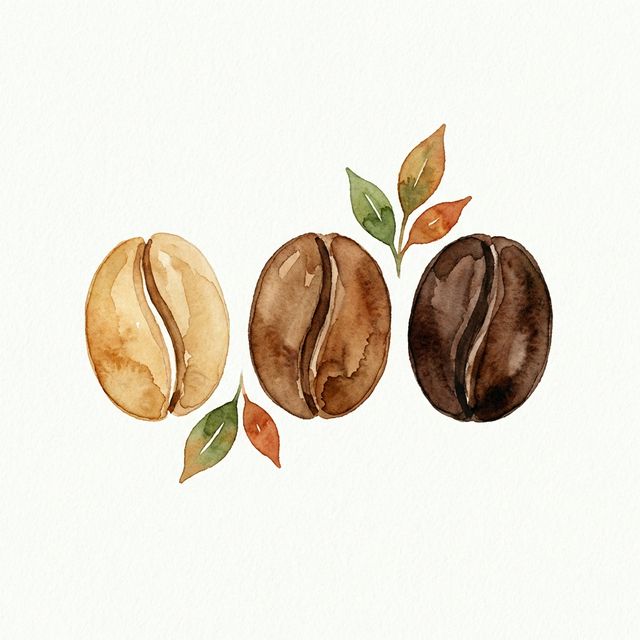
Chlorogenic acids — the antioxidant compounds we've been talking about through this entire series — degrade notably during roasting. Light roasts retain the most CGA. Medium roasts lose some, but still contain meaningful amounts. Dark roasts can lose 50-90% of their original CGA content.
Let me put numbers on that. A light roast might deliver 70-100 mg of CGA per cup. The same bean roasted dark might deliver 15-30 mg. That's not a subtle difference.
Trigonelline — the neuroprotective compound — follows a similar pattern. It breaks down during roasting, converting partly into niacin (vitamin B3). You gain some niacin, but you lose the trigonelline-specific benefits. Lighter roasts preserve more.
Caffeine, on the other hand, is remarkably stable. Light and dark roasts contain very similar amounts of caffeine per cup. There's a myth that dark roast has more caffeine — it doesn't. (There's also a myth that light roast has more — also not true. They're essentially the same.)
What roasting creates
It's not all loss. Roasting also creates beneficial compounds that aren't present in green coffee.
Melanoidins are formed during the Maillard reaction. They're large, complex molecules that have antioxidant and anti-inflammatory properties. Darker roasts contain more melanoidins than lighter roasts. So while you're losing CGA, the story isn't simply destruction — it's transformation. As CGA breaks down during roasting, the first compounds formed are CGA lactones, which have their own bioactive properties, particularly in the gut. These lactones peak at light-to-medium roast levels and then degrade further as roasting continues. Meanwhile, melanoidins form through the Maillard reaction and increase with darker roasts. Together with coffee's natural soluble fiber, these compounds — lactones, melanoidins, and coffee fiber — all contribute to gut health in ways that the original CGA doesn't. The antioxidant trade-off still favors lighter roasts, but the gut health picture is more nuanced than 'darker is worse.'
N-methylpyridinium (NMP) is another compound formed during roasting. It's been studied for its potential to reduce stomach acid secretion, which could make darker roasts gentler on sensitive stomachs. For people with GI issues — and many in our community have them — this is practical information.
It's also worth noting, as I mentioned in Post 5, that darker roasts contain less acrylamide than lighter roasts. So if acrylamide is a concern for you, that's one area where going darker works in your favor.
The health trade-off
Here's how I think about it.
If your primary concern is liver protection and antioxidant activity, lighter to medium roasts give you more of the compounds that have been most studied for those benefits. CGA is the star here, and it's a light-roast compound.
If your concern is stomach tolerance or you specifically want the melanoidin and NMP benefits, darker roasts have advantages.
If you're drinking coffee for the caffeine-specific anti-fibrotic effect, roast level doesn't matter much — caffeine stays consistent.
What Revi argues — and I think she's right — is that the sweet spot for most health benefits is a medium roast. You've preserved a real amount of CGA and trigonelline. You've developed some melanoidins and NMP. You've retained all the caffeine. And you haven't pushed the bean so far that you've destroyed most of what made it health-promoting in the first place.
Roast defects
There's another dimension Revi covers that I found eye-opening: roast defects.
If coffee is under-roasted, some of the raw organic compounds haven't been properly transformed, and the coffee can be harsh and acidic in ways that aren't pleasant or necessarily healthy. If it's over-roasted, beyond dark into the realm of charred, you're getting a lot of carbon and very little of the original health compounds.
And then there's uneven roasting — where some beans in the batch are lighter and others are darker. This inconsistency means an unreliable compound profile in every cup.
The point isn't to make everyone into a coffee snob. But if you're choosing coffee partly for health, understanding that the roaster's skill and intention affect what you're actually consuming — that's practical information.
What this means for you
You don't need to become a roasting expert. But here are the takeaways:
- Medium roast offers the best balance of health compounds for most people.
- Light roast maximizes CGA and trigonelline if antioxidant and liver protection are your top priority.
- Dark roast isn't harmful, but it delivers substantially fewer of the well-studied protective compounds.
- Quality matters more than you think. A well-roasted medium from a good roaster will deliver more health value than a poorly roasted light from a bad one.
For our community — people managing fatty liver disease, metabolic syndrome, or cirrhosis — I'd lean toward medium. You get the broadest spectrum of benefit with good flavor. But honestly, any roast that keeps you drinking coffee regularly is better than the "perfect" roast you don't enjoy.
Part 7 of an 8-part series on coffee and health. Final post coming next: brewing for health — water, filters, and what ends up in your cup.
Don't forget to check out Sober Livers, our research registry for people with liver disease who don't drink alcohol. Visit the Wellness League to find liver-aware providers near you.
Next in the series: Brewing for health — does how you make your coffee actually matter? →