
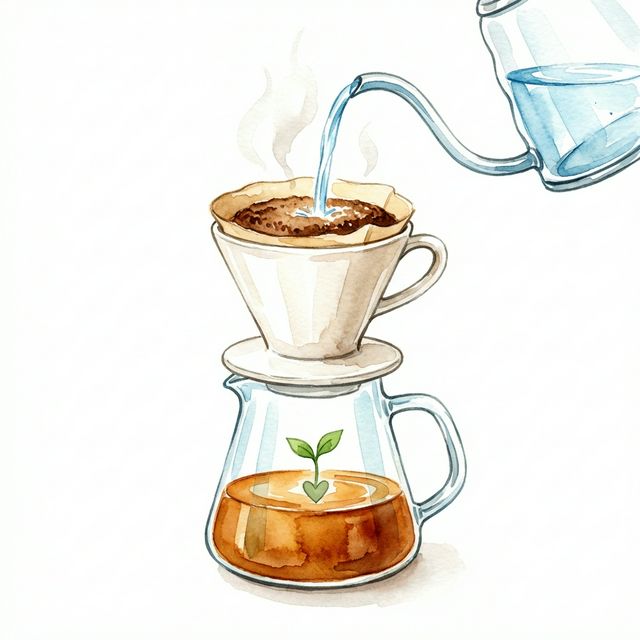
We've spent this whole series talking about what's in coffee and how growing, processing, and roasting affect the health compounds. But there's one more step — the one you control directly every morning — that determines what actually ends up in your body.
How you brew it.
I'm not going to tell you to throw out your coffee maker. But after reading the brewing chapter in Revi's book, I did look at mine differently.
The paper filter — this one matters most
If I could boil this entire post down to one recommendation, it's this: use a paper filter.
I mentioned this briefly in the first post of the series, but it's worth going deeper. Coffee beans contain two diterpene compounds — cafestol and kahweol — that are present in the oils. These compounds have been clearly shown to raise LDL cholesterol. The effect isn't trivial. Unfiltered coffee consumed regularly can raise LDL by 5-10% or more.
Paper filters catch these oil-borne compounds. Metal filters, French presses, Turkish coffee, espresso machines — they don't.
Now, here's the nuance. Cafestol and kahweol have also shown some anti-inflammatory and potentially anti-cancer properties in laboratory studies. So they're not purely "bad." But for people in our community who are already managing metabolic syndrome, elevated cholesterol, or cardiovascular risk alongside liver disease, the cholesterol-raising effect is the more immediate concern.
A large Norwegian study by Tverdal et al. found that filtered coffee drinkers had the lowest mortality risk of any group — lower than non-drinkers, and lower than unfiltered coffee drinkers. That's a meaningful finding.
Practical takeaway: drip coffee with a paper filter, pour-over, or an auto-drip machine with paper filters. These are the healthiest brew methods from a cholesterol perspective. If you love French press or espresso, consider adding a paper filter step, or at least being aware of the trade-off.
Water — 98% of your cup
This is something most people never think about. Your cup of coffee is roughly 98% water. The quality of that water matters.
Hard water (high in calcium and magnesium) can actually improve coffee extraction. Those minerals help pull bioactive compounds from the grounds more effectively. But extremely hard water can also create mineral deposits and off flavors.
Soft water, on the other hand, tends to under-extract — meaning fewer health compounds end up in your cup.
Chlorinated tap water can interfere with coffee flavor and potentially affect some of the more delicate compounds. A basic carbon filter — like a Brita pitcher — removes chlorine and improves water quality for brewing.
Revi recommends water with moderate mineral content, filtered to remove chlorine. You don't need to buy special coffee water. But if your tap water smells like a swimming pool, a filter is a worthwhile investment for both taste and health.
Brew method and extraction
Different brewing methods extract different amounts of the beneficial compounds.
Drip/pour-over (with paper filter): Good extraction of CGA and caffeine. Filters out diterpenes. This is probably the highest-health-value method for regular consumption.
Espresso: High-pressure extraction produces a concentrated shot with significant CGA per ounce, but typical serving size is small compared to a full cup of drip. No paper filter, so you're getting the diterpenes.
French press: Full immersion means longer contact time and good extraction of CGA. But no filter means full diterpene exposure. Fine for occasional use, but daily French press consumption means daily cholesterol exposure from cafestol.
Cold brew: Extended steep time (12-24 hours) extracts a smooth, low-acid coffee. CGA extraction is moderate — generally lower than hot brewing because heat aids compound extraction, though the extended steep time partially compensates. But the lower acidity can be easier on sensitive stomachs. Diterpene content depends on whether you filter through paper.
Percolator: Recirculates water through the grounds repeatedly, which tends to over-extract, pulling out more bitter compounds and potentially degrading heat-sensitive beneficial ones. Not ideal for health-focused brewing.
Moka pot: Produces a concentrated brew similar to espresso; less prone to over-extraction than a percolator, although the finished coffee can overheat in the pot if not careful.
Storage matters too
This is a small thing that makes a bigger difference than you'd expect. Coffee compounds begin degrading after roasting, but the process accelerates dramatically after grinding. The moment you grind, you increase the surface area exposed to oxygen, and oxidation starts breaking down CGA, trigonelline, and other bioactive compounds. Whole beans retain their compound profile much longer than pre-ground coffee.
Store whole beans in an airtight container away from light and heat. Don't freeze and thaw repeatedly. Buy in quantities you'll use within 2-3 weeks of roasting. If you can find coffee with a roast date on the bag (not just a "best by" date), that's a better indicator of freshness.
Grind immediately before brewing for maximum compound preservation. A basic burr grinder is a worthwhile investment.
Bringing it all together
Over eight posts, we've traced coffee from the research lab to the farm to the roaster to your kitchen. Here's the summary of what I've learned from Revi's book and what I think matters most for our community:
- Coffee genuinely protects the liver. The evidence is consistent across decades of research, involving multiple mechanisms — antioxidant, anti-fibrotic, anti-inflammatory.
- The research consistently shows benefits across a range of 2-5 cups per day: 3-5 cups show the strongest results for neuroprotection, while 2-4 cups are reasonable for most liver and metabolic benefits.
- Decaf retains most of the benefit, except for the caffeine-specific anti-fibrotic effect and the Parkinson's protection.
- Medium roast offers the best balance of health compounds.
- Paper filters remove the cholesterol-raising diterpenes.
- Quality matters — how coffee is grown, processed, and roasted determines the compound profile you actually consume.
- Not all coffee is the same, and Revi's concept of Circular Health Coffee — coffee produced with health as the primary goal — makes a compelling case for thinking about your cup differently.
I started this series by saying I'm a fan of coffee, and the research supports that. But I'm a bigger fan of giving you the information to make your own decisions. Whether you drink one cup or four, regular or decaf, light roast or dark — now you know what's behind the science.
And if nothing else, the next time someone tells you coffee is bad for your liver, you can smile and tell them to read the research.
This is the final post in our 8-part coffee and health series, inspired by Ildi Revi's The Coffee Guide to Better Health. Thank you for reading along.
One subject not covered Ildi's book "Instant vs Brewed: Is one better for you"
If any of this has been useful, I'd ask you to do two things. First, share it with someone in your life who might benefit. Second, visit us at fattyliverfoundation.org. Explore the Wellness League, and check out Sober Livers. We're building something here, and every person who joins us makes it stronger.